


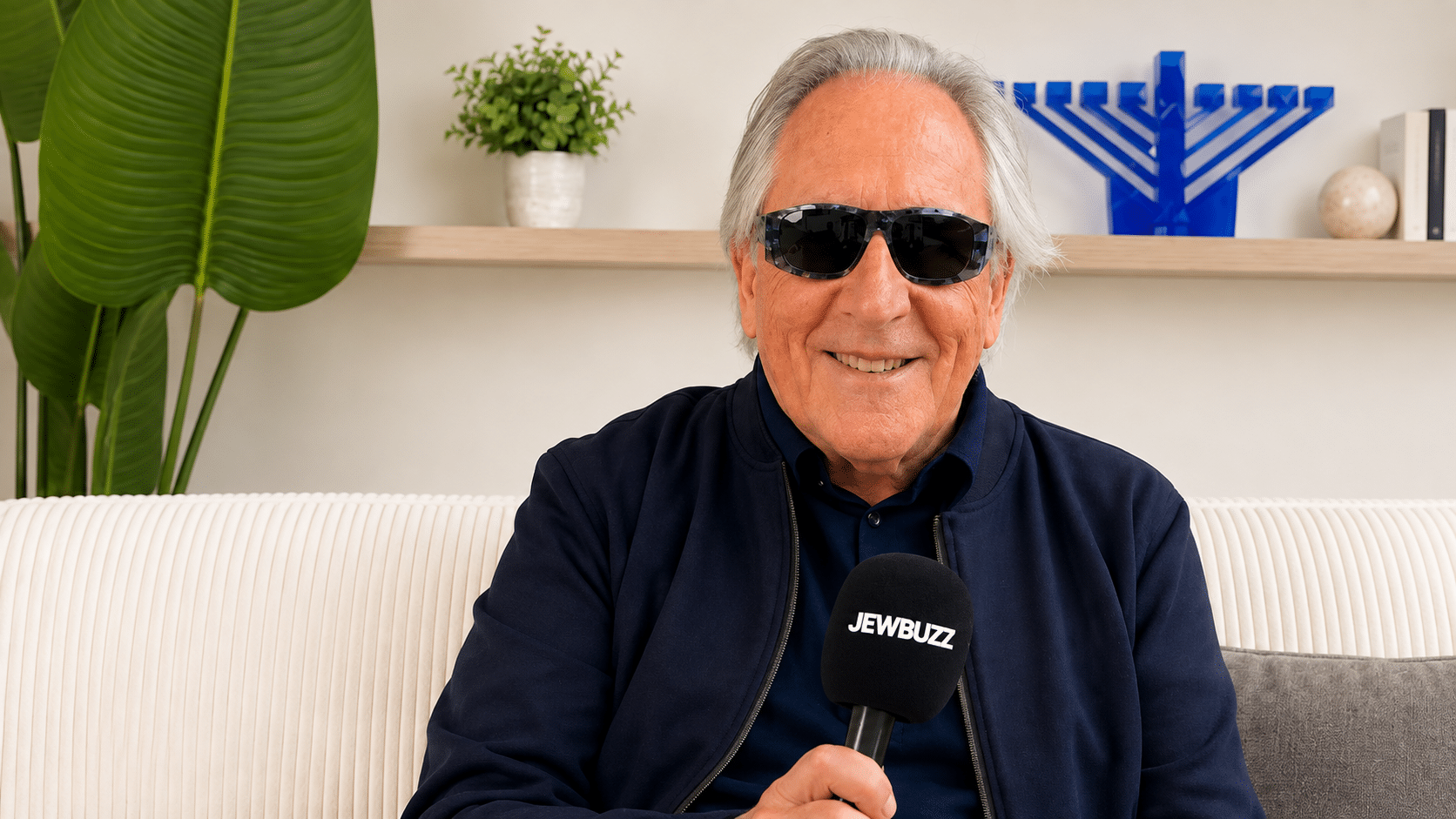
A few seconds with Gilbert Montagné are enough to understand that, behind the hits that have become classics, there is above all a man deeply attached to life, to passing things on and to others. Speaking to jewbuzz, the artist looks back with humour and emotion on fifty years of career, his memories, his identity and his view of the world.
His secret for getting through the decades without losing his enthusiasm? Gilbert Montagné answers almost immediately: he doesn’t really have one.
“My secret is that I love life. I sing life, I dance life, but above all I love heaven. Everything that matters comes to us from heaven.”
A philosophy that sums up the artist rather well. For him, music seems to work on instinct. When a melody comes to him, he prefers to catch it straight away rather than try to rebuild it later.
The stage remains his favourite playground. Even after several decades of concerts, Gilbert Montagné still speaks of that encounter with the audience as a kind of magic: the moment a song leaves its author to belong to thousands of people.
50 years on, still the same sense of wonder
From his first hits to the songs that have become inseparable from the celebrations of several generations, Gilbert Montagné has seen his audience renew itself without ever really disappearing.
And perhaps that is what still touches him the most: hearing very young people today know by heart songs that were sometimes released decades before they were born.
“It is still a wonder to know that, for 50 years now, my songs have found their way into your hearts.”
Les Sunlights des tropiques, On va s’aimer, The Fool and other tracks less immediately associated with his greatest hits continue to live on stage.
A popularity that even found a new audience thanks to Mask Singer, the show in which the singer slipped into the costume of the Tree. A memory he naturally recounts with humour.
Yet Gilbert Montagné doesn’t seem particularly nostalgic. He would rather embrace change than mourn a bygone era.
“Times change. It’s by accepting to evolve that we feel good.”
From the 45s of his teenage years to Johnny Hallyday
He nonetheless keeps a few very precise memories of his adolescence. At 13 or 14, he would cross Paris to buy his records on the Champs-Élysées. Marvin Gaye, Aretha Franklin, The Supremes… American music was already feeding his imagination.
A few years later, it was his own music he would hear coming out of the window of a neighbouring flat.
The scene has stayed etched in his memory. His first hit, The Fool, was suddenly no longer just a song recorded in a studio: someone he didn’t know was listening to it at home.
“I thought: ‘Wow… that means someone else has it!’”
His career would go on to bring him encounters he probably never imagined as a child, notably with Johnny Hallyday.
The two would share the stage. For Gilbert Montagné, finding yourself alongside an artist you admired a few years earlier is one of those moments that are hard to describe.
“When you’re 9 years old, you love an artist, and ten years later you find yourself by his side, those are extraordinary moments.”
Two roots that shaped his identity
The interview becomes more personal when it comes to his origins. Montagné is his real name. His father came from the Allier, in central France. His mother, Jeanne Galfond, was born in Algiers.
Gilbert Montagné thus speaks of two worlds, two family histories and two roots he grew up with.
On his mother’s side, the memory of the war and of fear left a deep mark on his family. A history he says still lives within him today.
“It was wonderful because I had both currents, both roots.”
“It’s harder, obviously, to be Jewish”
Impossible, in the current context, not to raise the issue of antisemitism with him.
Gilbert Montagné doesn’t try to play down what he sees. He expresses his astonishment that society can still be confronted with a hatred many might have believed belonged to the past.
“It’s harder, obviously, to be Jewish. It’s incredible to think we’re still here.”
He notably looks back on the rallies organised against antisemitism. While he is glad to see this mobilisation exist, he also regrets that the Jewish community is still too often the first to have to mobilise when it is itself the target.
Behind his words, however, Gilbert Montagné keeps coming back to the same idea: not to answer hatred with hatred.
“I don’t wish ill on anyone. I carry the eye of love and kindness. Truly, I want people to be well.”
A wish for peace between Israel and Lebanon
The artist also talks about Israel and Lebanon, two countries he considers far closer on a human level than their political history might suggest.
He speaks of peoples driven by the same desire to live, to dance and to smile, and expresses a very clear wish for the future.
“I make the wish that there will be peace between Lebanon and Israel.”
A sentence that ultimately matches the thread running through the whole conversation: with Gilbert Montagné, even the most serious subjects always end up leading back to the idea of coming together and of hope.
Telling the story of the child behind the artist
This desire to pass things on can also be found in his latest album, L’Amour dans ses mains.
Gilbert Montagné explains that he wanted to give the lyrics a different place there and to return more to his childhood, as if to understand what remains in each of us behind the adult we become.
“We are nothing more than children who grew up more or less well.”
A way of coming full circle for a man who continues, fifty years after his first hits, to write, record, take to the stage and, above all, to marvel.
Gilbert Montagné back on stage soon
And the story is far from over. Gilbert Montagné is already inviting his audience to what comes next, with a date announced at the Dôme de Paris on 14 February 2027.
A Valentine’s Day that seems rather well chosen for an artist who has spent much of his career singing about love.
An interview of memories, humour, identity and legacy, to watch in full in the video above.